FINDING MARY IN THE SCRIPTURES – Part XIV: Gospel Scripture Review Wrap Up
Fr. James McMillan, SMM
FINDING MARY . . .
Gospel Scripture Review Wrap Up
Over a span of a couple of years, . . .
The Queen began a series of articles on Our Lady in the Scriptures. It was certainly not intended as a complete study, so it was necessarily a sketchy series. (One could write a whole library of books on the subject.) Our Lady’s role in the story of our redemption has been scrutinized for centuries by the greatest saints and scholars in the Church.
The knowledge that we have of her comes from a long period of study and contemplation from the time of the Apostles. Our goal was the modest one of considering the more important references to Our Lady and to look at the meaning and significance of her various appearances in the written Word of God that we call the Bible.
Series Summary
It is time for us now to summarize that series, to review briefly the knowledge of her that can derive from the Scriptures. This will help us to obtain a more compressed and better organized view of her part in the redemption of the human race.
Let us start by emphasizing (as we should always emphasize) that Christ our Lord is the central point of the entire Bible. He is the hub around which everything else revolves. He is “the Alpha and the Omega,” the beginning and the end of all creation.
The events recorded in both the Old and the New Testament all have some reference to Him, either remotely or directly. It is Christ the Redeemer who is either prophesied about, or symbolized, or foreshadowed by everything mentioned or done in the Old Testament, as He is the “Word made Flesh” in the New Testament.
From the very beginning of the first book of the Bible, the Book of Genesis, Christ is the promised Redeemer. He is mentioned by God after the fall of Adam and Eve. God said to the serpent: “I will put enmities between you and the woman, between your seed and hers. He shall crush your head and you shall lie in wait for His heel.”
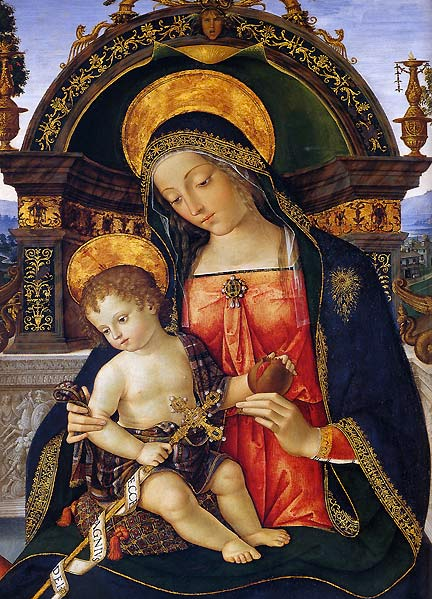
Madonna and Child: Italian Painter: Pinturicchio (1454-1513)
Also known as Pintoricchio or Pinturicchio. His formal name was Bernardino di Betto, also known as Benetto di Biagio or Sordicchio.
Return to The Queen: Articles
Note: This is the 14th article in this FINDING MARY IN THE SCRIPTURES series. The previous articles appear here.
But Christ our Lord, although the center and the main focus of the Bible, is not the only one mentioned as contributing to the salvation of the human race. Christ could have redeemed us all by Himself, without the help of cooperation of any human being. God chose . . . He was in no way forced . . . to allow the human race to join with Christ in restoring to us the lost kingdom of Paradise.
God had made Adam the representative of all of mankind in the Garden of Eden. Adam sinned in our name and we were lost. In much the same way, God made His only Son the representative of mankind in its restoration to the favor of God. Christ was “obedient unto death” in our name and so we are saved by His death.
Note the Parallelism
But note the parallelism in the story of Adam’s fall and in the story of the promise of the Redeemer. In both, there is mention of a woman who contributes: one to the fall and the other to the coming redemption. Both of these women have an active, although subordinate, part to play. Eve co-operates with Adam in bringing about his downfall. And there is a promised woman, one yet to come, who will join with the redeemer in crushing the serpent’s head.
Christ is the Only Redeemer
We must stress over and over again, that Christ is the only Redeemer. Others may cooperate with Him, but He alone is the “Mediator between God and man,” as St. Paul tells us. God chose “the woman” (Our Blessed Lady) to cooperate, as much as a human being could, with Christ in His saving work. How she cooperated with Him is foreshadowed and prophesied in the Old Testament and made explicit in the gospels of the New Testament.
We are all familiar with one of the meanings of prophecy: to foretell coming events.
Prophecy and . . .
Foreshadowing is a kind of hint of things to come. Thus, the prophecies of Isaias and Jeremiah told of the coming Redemption. The liberation of the children of Israel from the bondage of Egypt was a foreshadowing of our liberation from sin and death.
So it is that the Church sees prophecy and foreshadowing with reference to Our Lady in the Old Testament. Women like Sarah, Esther, Judith and the mother of the Machabees convey a hint of the courage and devotion of Our Blessed Lady in the life of Christ.
This is how the Second Vatican Council explained it: “The sacred writings of the Old and New Testaments. . . show the role of the Mother of the Savior in the plan of salvation in an ever clearer light and call our attention to it.
The books of the Old Testament describe the history of salvation, by which the coming of Christ into
the world was slowly prepared. The earliest documents, as they are read in the Church and are understood in the light of a further and full revelation, bring the figure of the women, Mother of the Redeemer, into a gradually clearer light…
. . . Foreshadowing
“She is already prophetically foreshadowed in the promise of victory over the serpent which was given to our first parents after their fall into sin. Likewise, she is the virgin who shall conceive and bear a son, whose name shall be called Emmanuel . . . After a long period of waiting the times are fulfilled in her . . . when the Son of God has taken human nature from her, that He might in the mysteries of His flesh free man from sin.”
Prophecy and foreshadowing are used in the Old Testament to portray Our Lady’s role in the Redemption. In the New Testament we see the fulfilling of these prophecies and the realization of all the foreshadowing.
We shall summarize Our Lady’s role in the New Testament in our next publication.
(The series continues)
M1984.11