FINDING MARY IN THE SCRIPTURES – Part XIII: After the Resurrection
Fr. James McMillan, SMM
FINDING MARY . . .
After the Resurrection
In the Second Vatican Council, the Church tells us . . .
. . . that: “In the public life of Jesus, Mary appears prominently.” These prominent appearances are listed as: the marriage feast of Cana, when Christ was preaching to the crowds, and at the supreme mo-ment when she stood at the foot of the Cross and watched her Son die for our salvation.
The Gospels . . .
The foot of the Cross is the last time that the Gospels mention her. True, she is referred to later on in the New Testament. St. Paul speaks of her, but not by name, in his letter to the Galatians:
“,.. . when the fulness of time came, God sent His Son, born of a woman.. .”
And St. Luke in the Acts, mentions that she was present in the upper room with the apostles, awaiting the coming of the Holy Spirit at Pentecost: “They were persevering with one mind in prayer with the women and Mary the Mother of Jesus, and with His brethren.”
. . . Mention Her
None of the Gospel writers mention her as being present at the Resurrection of Christ or during the forty days that He stayed with His disciples. He appeared, the Gospels tell us, to Mary Magdalen and the disciples. He makes a dramatic appearance to the Apostle Thomas, clearing up Thomas’ doubts about the risen Lord. But the Gospels say nothing about Christ’s appearing to His own Mother. One can’t help wondering why this was so.
Certainly, it was not because He had ceased to love her and care for her. And it was definitely not . . . as one writer suggested years ago . . . because He wanted to show His apostles and everyone else that she was no longer of any importance to the salvation of the human race, that her role was completely finished, that He was now repudiating her.
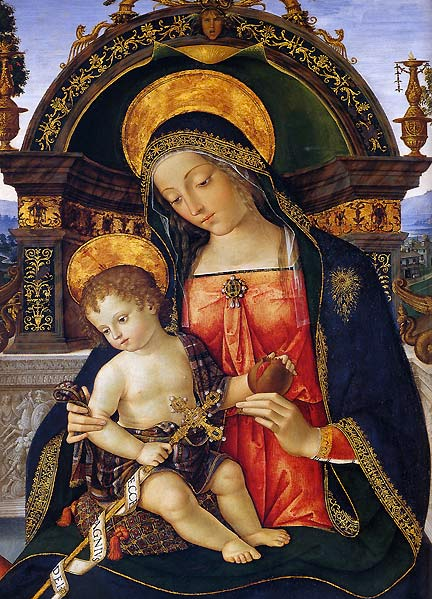
Madonna and Child: Italian Painter: Pinturicchio (1454-1513)
Also known as Pintoricchio or Pinturicchio. His formal name was Bernardino di Betto, also known as Benetto di Biagio or Sordicchio.
Return to The Queen: Articles
Note: This is the 13th article in this FINDING MARY IN THE SCRIPTURES series. The previous articles appear here.
Vatican 2 States Her Role did not Finish with the Death of Christ
Vatican 2 makes it quite clear that her role did not finish with the death of Christ: “The mother-
hood of Mary in the order of grace continues uninterruptedly from the consent which she loyally gave at the Annunciation and which she sustained without wavering beneath the cross, until the eternal fulfillment of all the elect. Taken up to heaven she did not lay aside this saving office but by her manifold intercession continues to bring us the gifts of eternal salvation.” Note the repetition of the word “continues.” There was no time when she was told to relinquish her part in the salvation of the human race.
Then what conclusion can we draw . . .
. . . from the silence of the gospels about whether or not Christ appeared to His Mother after His Resurrection from the dead?
First of all, the gospels do not tell us that Christ did not appear to His Mother. At the end of his gospel, St. John warns us: “There are many things that Jesus said and did that are not written in this book. If all of it were put in writing, I do not think the world itself would contain the books which would have to be written.”
For example, the gospels never tell us that Christ yawned or combed His hair or even that He laughed once in a while. There was no need to mention things like this. We know that Christ was like us “in all things but sin.” So, obviously, He yawned and combed His hair and broke into an occasional chuckle. He wouldn’t have been like us if He hadn’t.
The Things Told us in the Gospels are “For Our Salvation”
The things told us in the gospels are “for our salvation,” and “so that we may believe in Him.” That is why the gospels recount His miracles: so that we may believe He is truly the Messiah sent by God for our redemption. That is why they tell us of His preaching: “so that we may have life in His name.” That is why they narrate, in terse and precise language, the story of His suffering and death and Resurrection from the dead: so that we may accept Him as the risen Savior of the world.
There was no need for the gospels to stress His appearing to His Blessed Mother, probably before He appeared to Mary Magdalen and His disciples. The gospels needed to tell of these appearances, for the faith of the disciples and of Mary Magdalen had been shattered by the events of His suffering and death.
Our Lady had no need of this reassurance. She never for a moment lost her faith in her divine Son. No doubt she wondered how her Son was going to restore the Faith of His followers. Maybe she suspected that He would rise from the dead, but she had no absolute assurance of this.
Christ was—and still is—the perfect Son of the perfect Mother. It is impossible to imagine Him not appearing to her first of all. And it must have been the most glorious and joyful reunion in the history of the world.
(The series continues)
M1984.09