Saint Pope John Paul II Honors Our Lady’s Two Birthdays
Fr. Roger Charest, SMM
Saint Pope John Paul II Honors Our Lady’s Two Birthdays
When Pope John Paul II went on a personal pilgrimage to Lourdes, . . .
. . . on August 15th, 1983 (see the cropped photo above and the July 1984 cover on the artwork website), he went “not simply to honor Mary’s birth in heaven on this solemn feast of the Assumption, but also to honor the happy moment of her birth on this earth.”
The Pope Celebrated Mass . . .
For the first time in history, a Pope celebrated Mass at the Grotto of Apparitions in Lourdes. It was a Monday morning, feast of the Assumption of the Blessed Virgin Mary. On that memorable occasion, he spelled out, for all the world to know, the two principal reasons that motivated him to make this pilgrimage. The first was to celebrate Mary’s “definitive birth in heaven” (Assumption); the second, to honor and celebrate “her birth on this earth.”
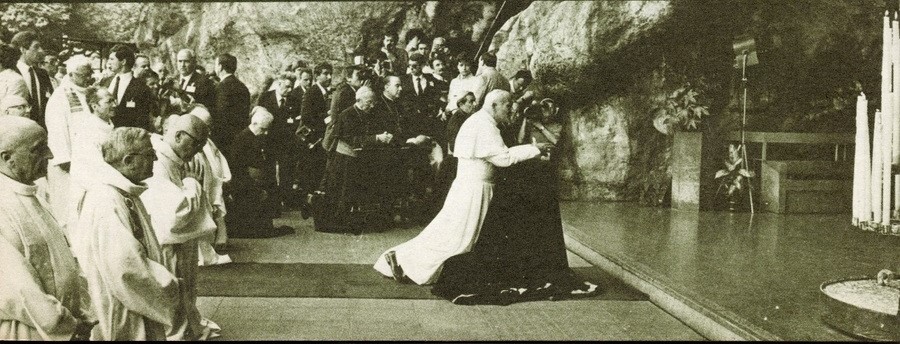
Saint Pope John Paul II at Lourdes: cropped art of The Queen’s cover from July 1984
Return to The Queen: Articles
In his splendid homily at the Mass that day, the Holy Father reminded his hearers—and through them, the whole Church— of two important birthday anniversaries that would soon be upon us namely, the 2000th anniversary of Mary’s birth and the 2000th anniversary of the birth of her Son, Our Lord and Savior, Jesus Christ.
. . . at the Grotto of Lourdes
He not only alluded to these two anniversaries, but he strongly suggested that they be given their proper importance and appropriate celebrations. He linked them together since they are both included in the salvific event — Mary’s birth not only preceding but heralding the birth of the Savior Himself.
Here is how he put it, as translated in the English Edition of the Osservatore Romano of Sept. 5, 1983:
In the Assumption of the Mother of God into heaven, . . .
. . . her birth in heaven, we want to honor the blessed moment of her birth on earth. “Many ask themselves: when was she born? when did she see the light of day? This question is being asked now especially as we approach the second millennium of the birth of Christ. The birth of the Mother obviously had to come before the birth of her Son. So, would it not be appropriate to celebrate first the second millennium of the birth of Mary?
The Birth of Mary is Important. . .
“The Church has recourse to history and historical dates in order to celebrate anniversaries and jubilees (taking into account the precisions supplied by science). All the same, the true rhythm of anniversaries and jubilees is set by the history of salvation. So, we want especially to situate in time the events related to our salvation and not only to note with historical precision the moment of these
events.
“In this sense, we agree that this year’s Jubilee of Redemption relates to the events of Calvary 1950 years ago, that is, to the death and resurrection of Christ. But all the attention of the Church is directed primarily to the salvific event (besides consideration of the date) and not to the historical date alone.
“At the same time, we constantly recall that this year’s extraordinary Jubilee is preparing the Redemption, we want to enter into this Advent. We want to share in the expectation of Mary, the Virgin of Nazareth. In the jubilee of this salvific event, which is also like an Advent, we want to include also her own coming, her own birth on earth.
. . . is Important
“Yes, the birth of Mary is the beginning of the salvific Advent.
“And that is why we make this pilgrimage to Lourdes: not only to honor the birth of Mary in heaven through the solemn feast of the Assumption, but also to honor the blessed moment of her birth on earth.
“We come on pilgrimage to Lourdes where Mary, “The Beautiful Lady,” said to Bernadette: “I am the Immaculate Conception.”
“With these words, she explained the mystery of her birth on earth as a salvific event very closely linked to the Redemption—and to Advent.”