FINDING MARY IN THE SCRIPTURES – Part XI: Who Are My Mother and My Brothers?
Fr. James McMillan, SMM
FINDING MARY . . .
Who Are My Mother . . .
The marriage feast of Cana is generally . . .
. . . taken to mark the beginning of Christ’s public life, the time when He began to proclaim Himself to be the Messiah and to preach the coming of the Kingdom of God. It was during this period of some three years that He instructed His apostles in the meaning of the Kingdom, spoke to the crowds and performed His great miracles, especially curing the sick and raising the dead to life again. His purpose was to convince His disciples and followers and the people of Israel that He was indeed the Messiah sent by God to redeem the world.
It was, as we know from the gospels, a difficult task even for the Son of God made man. His contemporaries were not at all prepared to accept a Messiah who would undergo suffering and death. They had been conditioned over the course of the centuries to look for a Messiah who would be a great conqueror, one who would re-establish the glory of the ancient kingdom of David and Solomon. In their minds, the Anointed One would drive the Romans out of Palestine, set Himself up as king of the Jews, and give them immediate paradise here on earth.
The Apostles themselves were imbued with this notion of a conquering Messiah and an earthly kingdom. Even after His resurrection from the dead, they continued to ask Him: “Will you at this time restore the kingdom of Israel?” And when Christ informed them that they were to go up to Jerusalem where He would be mocked and scourged and spat upon and put to death, Peter, no doubt speaking for the others as well, re-belled against such an idea: “This will never happen to you, Lord!” Christ had to remind Peter that he was speaking in human terms and not thinking the way God thinks.
. . . and My Brothers?
Among those who were puzzled by His actions and statements were His own relatives and friends, people from His own town of Nazareth, people who had no doubt known Him for years.
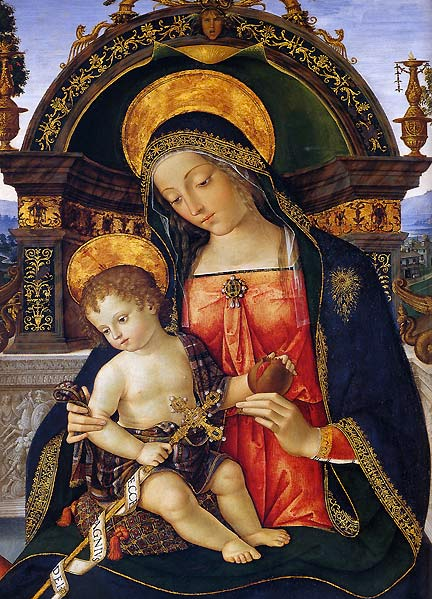
Madonna and Child: Italian Painter: Pinturicchio (1454-1513)
Also known as Pintoricchio or Pinturicchio. His formal name was Bernardino di Betto, also known as Benetto di Biagio or Sordicchio.
Return to The Queen: Articles
Note: This is the 11th article in this FINDING MARY IN THE SCRIPTURES series. The previous articles appear here.
St. Mark tells us in his gospel that “… many were astonished when they heard Him“; How did He come by all this? they asked. What is the meaning of this wisdom that has been given Him, of all these wonderful works that are done by His hands? Is not this the carpenter, the son of Mary, the brother of James and Joseph and Judas and Simon? Do not his sisters live near us? And they had no confidence in him.” St. Mark tells us that Christ was astonished at their unbelief and told them: “It is only in his own country, in his own home, and among his own kindred, that a prophet goes unhonored.”
This, of course, did not apply to our Blessed Lady. She was still “pondering these things in her heart” and seeing Him when she had the opportunity. And whenever Christ referred to her during His public life, it was to praise her for her faith and trust in Him.
Vatican 2 Reminds Us
Vatican 2 reminds us that “In the public life of Jesus, Mary appears prominently at the very beginning when at Cana, moved with pity, she brought about by her intercession the beginning of miracles of Jesus the Messiah. In the course of her Son’s preaching, she received the words whereby, in extolling a kingdom beyond the concerns and ties of flesh and blood, he declared the word of God as she was faithfully doing.” Christ’s astonishment at the unbelief of His neighbors, friends and relatives did not extend to her.
There are Two Instances in the Gospels where Christ proclaims that Our Lady is Blessed
There are two instances in the gospels where Christ proclaims that she is blessed because she heard and kept the word of God. St. Luke recounts the incident when a woman in the crowd was so carried away by Christ’s preaching that she exclaimed: “Blessed is the womb that bore you and the breasts that nourished you!”
It is hard to imagine that Christ was not pleased with this praise of His mother. But He reminded the woman of an even greater reason for so blessing the mother of the Messiah: “Shall we not say, Blessed are those who hear the word of God and keep it?”
This is what Our Lady had been doing from the moment of the Annunciation when she replied to the angel Gabriel: “Behold the handmaid of the Lord; be it done unto me according to thy word.”
St. Mark: Thy Mother and Thy Brethren
There is another instance, this time in the gospel of St. Mark. “… his mother and his brethren came and sent a message to him, calling him to them while they stood outside. There was a multitude sitting around him when they told him, Here are thy mother and thy brethren outside, looking for thee. And he answered them, Who is a mother, who are brethren, to me? Then he looked about at those who were sitting around him, and said, Here are my mother and my brethren! If anyone does the will of God, he is my brother and sister and mother.”
What Christ is telling the crowd is that they cannot truly be His brothers and sisters unless they first do what Our Lady had been doing all her life: follow the will of their Father and His.
These “prominent appearances” of Our Lady (as the council calls them) were to give Christ an opportunity to point out that it is not the ties of flesh and blood that make one blessed in the sight of God. The most important thing in the Kingdom of God is “to do the will of My Father in heaven.”
(The series continues)
M1984.05