Montfort and A Most Neglected Book
Fr. Roger Charest, SMM
A Most Neglected Book
Recently, I asked myself a question which had never really occurred to me before: . . .
. . . “If St. Louis de Montfort were to pay us a visit, which one of his writings would he single out to us as being very important and relevant for our times?”
I know he predicted that his book “True Devotion to Mary” would be lost in the silence of a coffer — and it was indeed lost for 126 years after his death. But I’m afraid that an even more important work of his, “The Love of Eternal Wisdom” has suffered an even worse fate.
A Book That Has Suffered . . .
True, the original manuscript was never lost, but then again it was never duly promoted by his followers. Yes, we always did say that it was his key book, his masterpiece, etc.
But when it came to our preaching and teaching, we never really gave it half the attention we gave to his “True Devotion To Mary,” even though we knew that the latter was but a fuller development of the last Chapter of “The Love of Eternal Wisdom.”
One of the reasons, among others, why Montfort’s sons have not over the years stressed the importance of his book, “The Love of Eternal Wisdom,” is that the very term “Wisdom” can be a very abstract term . . . unless it is identified with St. Paul’s description of Christ, when he wrote: ”I want to know nothing but Christ and Christ Crucified . . . in whom are hidden all the Treasures of Wisdom and knowledge.”
. . . an Even Worse Fate
However, the Old Testament notion of Wisdom, as portrayed in the “Wisdom Books,” has nothing abstract about it. In fact, Wisdom is described in very concrete terms, closely linked with our everyday lives and questions concerning the meaning of our very existence.
A second reason, I believe, why we Montforts have not generally speaking given this book its full and proper recognition in our preaching may be because many of us felt that due to the abundance of Scriptural quotations there was nothing too original about it. Or, again, that one would have to be a trained exegete, or Scripture scholar, to really appreciate it or even to attempt to explain it to others. Hence, we were likely to look upon it as a book written only for a certain spiritual elite and not one written for the general public, so to speak.
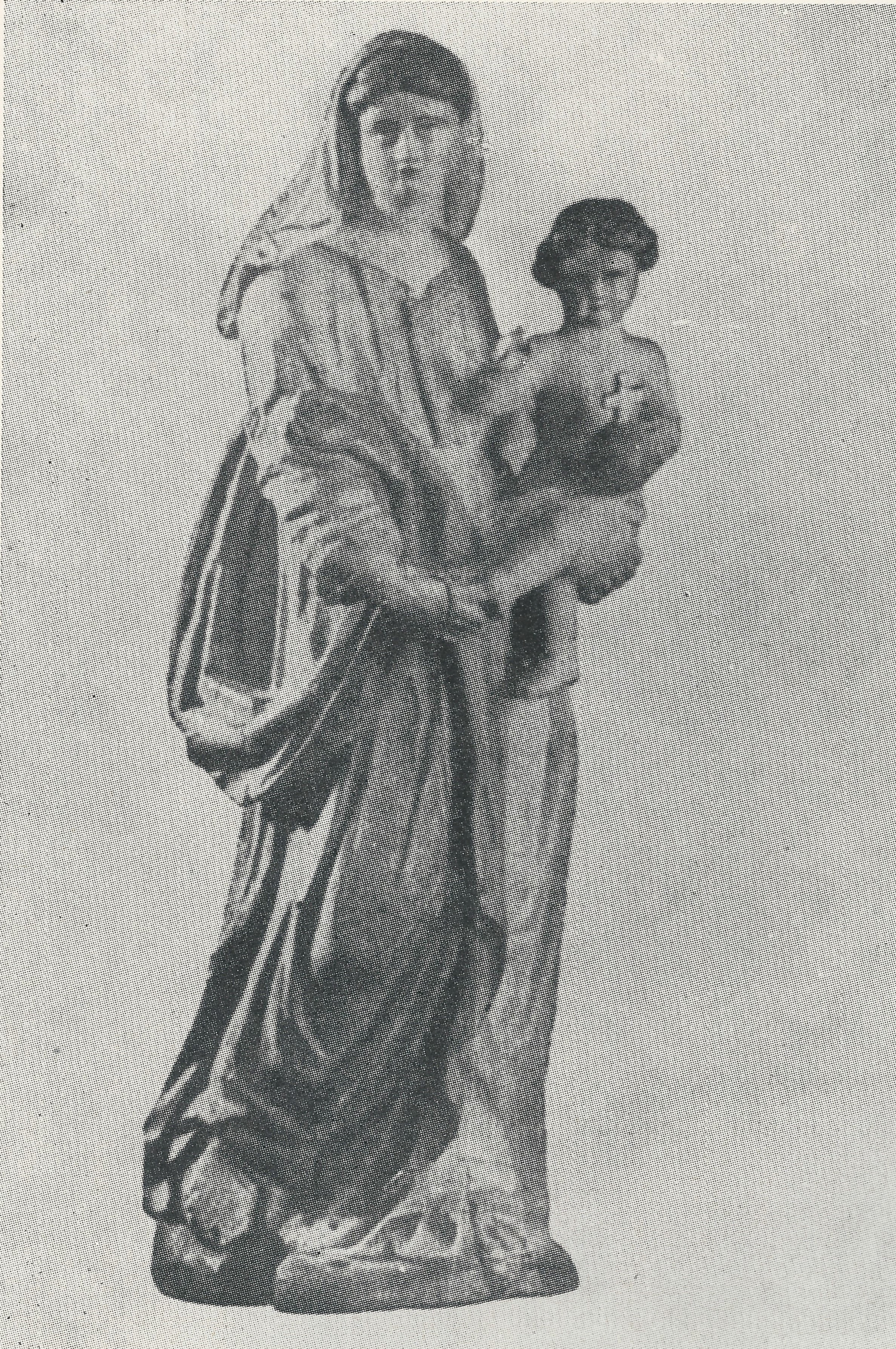
Our Lady of Saint Amand: Fr. de Montfort: 1714
I n the year 1714, St. Louis gave a mission at St. Amand . . .
. . . where the people were credulous and superstitious. They attributed sickness and other misfortunes to those of their number who were supposed to practice black magic. To overcome these difficulties, the missionary preached devotion to the Blessed Virgin and time proved the efficacy of his work for these troubles never occurred again. Tradition holds that, to assure their perseverance, St. Louis Mary carved this, his last statue which has always been preserved in that parish. Many affirm that they have received favors through the intercession of St. Louis as a result of prayers said before this statue.
Return to The Queen: Articles
Communicate to Me Some of . . .
On the other hand, I will never forget the first time I read it- back in my Novitiate days. I remember reading it in one sitting, I remember the impact it had on me. I could almost hear Montfort speaking to me and trying to communicate to me some of his burning desire to possess and to be possessed by Jesus Christ, Eternal and Incarnate Wisdom.
In his Prayer to Divine Wisdom, which served as introduction to his book, he wrote: “Deign then, O loving Prince, to listen to my feeble stammering’s as if they were masterly discourses. Deign to consider every stroke of my pen as so many efforts on my part to find Thee; and bestow from Thy high throne above, so much grace and light on what I intend to do and to say about Thee, that all those who read it may be inflamed. with a new desire to love and possess Thee in time and in eternity.”
. . . His Burning Desire
There is no doubt that as Father Maurice Gilbert, S.J., pointed out in his recently published article, “Montfort’s Spiritual Exegesis”, Montfort’s book is both an original and unique contribution to the full interpretation of the Old Testament! ‘Wisdom Books” as seen in the light of New Testament exegesis, particularly St. Paul; to say nothing ‘of how his interpretation is very much in line with the “findings!’ of many of today’s Scripture scholars. (Remember, Montfort wrote more than three hundred years ago!)
B ut Montfort’s goal was more than just Scriptural exegesis.
His goal was to give us a fuller comprehension of the entire Bible from the viewpoint of Wisdom which is a theme that runs through all of Scripture, the Old as well as the New Testament. His ambition was to help us discover for ourselves this fascinating aspect of Eternal Wisdom whose greatest desire is to communicate with and give Himself to man in the person of Our Lord and Savior Jesus Christ, Incarnate Wisdom, Son of the Father from all eternity, Son of Mary in time.
The Greatest Means and the Most Wonderful of All Secrets for Obtaining and Keeping Divine Wisdom
You’ve guessed it, Montfort sees Mary as indispensable in God’s plan in our quest for Divine Wisdom. “The greatest of all means and the most wonderful of all secrets for obtaining and keeping Divine Wisdom, is a tender and true devotion ‘to the Blessed Virgin Mary.”
His reasoning is very simple. It begins like this: “No one but Mary has ever found grace with God for herself and for the whole human race. No one but Mary has had the power to conceive and give birth to Eternal Wisdom. And no one else has the power to bring Him to life; as it were, through the cooperation of the Holy Spirit, in the souls of those chosen by Him.”
For Montfort’s “other reasons,” you’ll have to read his book!