FINDING MARY IN THE SCRIPTURES – Part X: The Marriage Feast of Cana
Fr. James McMillan, SMM
“Christ responded to her request by performing His first miracle”
FINDING MARY . . .
The Marriage Feast of Cana
The first appearance of Our Blessed Lady in the public life of Christ . . .
. . . took place at the Marriage feast of Cana. It was here that Christ worked His first miracle. The event is related in the second chapter of the gospel of St. John and is significantly placed just two days after Christ had chosen His apostles.
At their choosing, the apostles had manifested their belief in Christ as the promised Messiah. As Philip told Nathanael: “We have discovered who it was Moses wrote of in his law, and the prophets too: it is Jesus the son of Joseph, from Nazareth.”
Their Faith Was Only at the Beginner’s Stage
Their faith, however, was only at the beginner’s stage: the acceptance of Christ as the promised Messiah. For like the rest of the people of the time of Christ, the apostles were looking for a Messiah who would restore the kingdom of Israel to its former glory. They awaited an earthly conqueror, a king like David or Solomon. The concept of a Messiah who was to suffer and die for the salvation of the human race was something that was far from their minds, a truth that they were as yet unable to grasp much less accept.
Linking the Choosing of the Apostles with the First Miracle of Christ
St. John, in his gospel, links the choosing of the apostles with the first miracle of Christ, the changing of water into wine at the marriage feast of Cana. It was, the gospel tells us, a “sign” that “made known the glory that was His, so that His disciples learned to believe in Him.” To them, it was a confirmation of their belief, a manifestation of the power and glory of Christ, a first step in their understanding of the kind of Messiah Christ was to be.
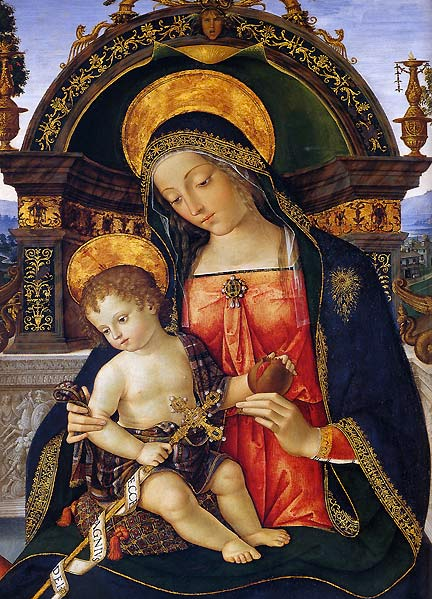
Madonna and Child: Italian Painter: Pinturicchio (1454-1513)
Also known as Pintoricchio or Pinturicchio. His formal name was Bernardino di Betto, also known as Benetto di Biagio or Sordicchio.
Return to The Queen: Articles
Note: This is the tenth article in this FINDING MARY IN THE SCRIPTURES series. The previous articles appear here.
“Two days afterward,” writes St. John, referring to the choosing of the disciples, “there was a wed-ding feast at Cana, in Galilee; and the mother of Jesus was there. Jesus Himself, and His disciples, had also been invited to the wedding. Here the supply of wine failed; whereupon the mother of Jesus said to Him, . . . They have no wine left. Jesus answered her, Woman, why dost thou trouble me with that? My time has not come yet.”
This is a passage that has given rise to a great deal of comment. Why does Christ address His mother as “woman”? Why the apparent refusal in Christ’s answer: “Why dost thou trouble me with that?” Precisely what did Christ mean by: “My time has not come yet’? What time or “hour” is He referring to: the time for His first miracle to be worked or the time of His death?
Why does Christ Address His Mother as “Woman”?
Practically all commentators agree that the word “woman” was not used in the ancient world as an indication of disrespect or with any suggestion of dishonor. It was still, even in those days, an unusual way of addressing one’s mother, and no doubt Christ had a special reason for using it.
But the reason would only become clear later on at the foot of the cross. It was then that Christ addressed her as “woman” for the second time: “Woman, behold thy son.” Christ then proclaimed that she was not only the mother of the Redeemer, but the “Woman of faith” who was the mother of all mankind.
It is quite clear that Our Blessed Lady did not take the words of Christ as a refusal: “Why dost thou trouble me with that?” She had no hesitation in telling the servants: “Do whatever He tells you.” And it was then that Christ instructed the servants to fill the water pots with water, to draw some out and “give a draught to the master of the feast.”
St. John goes on to explain how the “master of the feast” was somewhat puzzled because the bridegroom had “kept the best wine until now.”
The Main Point of the Story of the Marriage Feast
The main point of the story of the marriage feast is, as St. John tells us, Christ manifesting “the glory that was His, so that His disciples learned to believe in Him.” It is, however, important to note that St. John also stresses the reason for Our Lady’s presence at the celebration: so that she could intercede with Christ for the sake of the young couple and their wedding guests. We don’t know with any degree of certainty that she was asking for a miracle, or that she was requesting Him to advance what He called His “hour” or “time.” But she certainly knew that He was capable of doing something to relieve an embarrassing situation.
Christ responded to her request by performing His first miracle: the changing of water into wine. And it is the first indication that we have in the gospel of her power of intercession, that Christ Himself listens to her prayers and grants her requests.