FINDING MARY IN THE SCRIPTURES – Part IX: The Finding of Jesus in the Temple
Fr. James McMillan, SMM
FINDING MARY . . .
Jesus in the Temple
The story of the Finding of the Child Jesus in
the Temple, as narrated by St. Luke, . . .
. . . is the only incident that the gospels recount of the boyhood of Christ. The gospel writers leave us to assume that His childhood, adolescence and young manhood were much like those of the people of His time, living in Palestine and following the law of Moses.
In the early years of Christianity, there was a great deal of conjecture about His growing years. The so-called apocryphal gospels, like that of St. James and St. Thomas, tell rather spectacular stories of miracles and wonders that Christ was supposed to have performed while He was growing up in Nazareth.
The Church, however, has never accepted these “gospels” as authentic and has rejected them as unreliable works of fantasy.
St. Luke uses the incident of the finding in the temple as a kind of transition from Christ’s infancy to His public life. It took place when Christ had reached the age of twelve, the time when a Jewish boy attained legal manhood and was now held to the observance of the law of Moses.
As Was the Custom . . .
“Every year,” writes St. Luke, “his parents used to go up to Jerusalem at the paschal feast. And when He was twelve years old, after going up to Jerusalem, as the custom was at the time of the feast, and completing the days of its observance, they set about their return home.” The distance from Nazareth to Jerusalem was some 75 miles, most of it uphill.
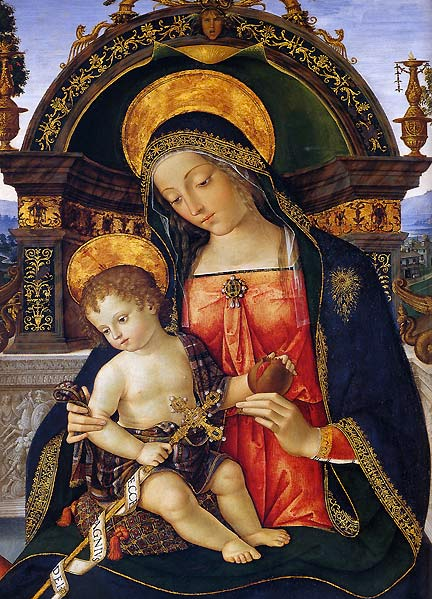
Madonna and Child: Italian Painter: Pinturicchio (1454-1513)
Also known as Pintoricchio or Pinturicchio. His formal name was Bernardino di Betto, also known as Benetto di Biagio or Sordicchio.
Return to The Queen: Articles
Note: This is the 9th article in this FINDING MARY IN THE SCRIPTURES series. The previous articles appear here.
. . . at the Time
Most of the travelers went on foot, and grouped together for protection from bandits and wild animals. As was the custom at the time, the men and women travelled separately. They would, of course, remain within sight of each other. Children would travel either with the men or with the women. The two groups gathered together at night for the evening meal.
The child Jesus, His parents, and the other travelers from Nazareth were only part of the enormous crowd that had come up to Jerusalem for the celebration of the Passover. People flocked there from all over Palestine, for this was the most sacred feast of the year. And not the least of the attractions for the multitude was the construction that was still going on to finish Herod’s new and magnificent temple. To the pious Jews, this was an event of great importance.
When it was time to return to Nazareth, “…
. . . the boy Jesus, unknown to His parents, continued His stay in Jerusalem. And they, thinking that He was among their travelling companions, had gone a whole day’s journey before they made inquiry for Him among their kins-folk and acquaintances. When they could not find Him, they made their way back to Jerusalem in search of Him, and it was only after three days that they found Him.
After Three Days They Found Him
One can imagine the anguish and the consternation of Our Lady and St. Joseph when they realized that the boy Jesus was not in either group, the men or the women, when they stopped for the evening. They hurried back to Jerusalem – a full day’s journey- to look for Him in that city teeming with Passover visitors. When they finally found Him, “He was sitting in the temple, in the midst of those who taught there, listening to them and asking them questions …”
Our Lady’s question was one that any mother would ask: “My Son, why hast thou treated us so? Think what anguish of mind thy father and I have endured, searching for Thee.” Christ’s answer is rather mysterious: “What reason had you to search for Me? Could you not tell that I must be in the place which belongs to My Father?”
Certainly, Christ was not insensitive to His parents’ anguish. He knew that His being lost would cause them pain and concern. But He assuredly had good reason for having them undergo such sorrow, a reason that we can only guess at.
Perhaps He was giving His mother and father a foretaste of what the Redemption would cost in terms of suffering for Himself and for His mother. St. Luke tells us that these words which He spoke to them were beyond their understanding.”
But, no doubt, Our Blessed Lady “pondered these things in her heart,” just as she pondered the events of His childhood. She had had to grow in deeper understanding of the meaning of her role in the Redemption of mankind. God was revealing His plan of Redemption to her little by little, and her faith was certainly strong enough for her to realize that, in the words of Simeon, a sword would pierce her heart.