The Queen: Editorial: He Came in Poverty
Fr. James McMillan, SMM
Editorial: He Came in Poverty
There were dozens of different ways . . .
. . . in which the Redeemer could have come into the world.
He could have come, as He was expected to come, as a great king, a conqueror who would crush the enemies of Israel and set up a paradise here on earth for His chosen people.
But He chose to be born in Bethlehem of Juda, an insignificant little town in an insignificant country that the Romans, after their conquest, had re-named Palestine as an insult to the Jews.
Had God appointed a committee of human experts to select a place and a time for His coming, they would never have picked the land of Israel during the Roman occupation. And had God insisted upon Palestine, the committee would never have suggested the town of Bethlehem. Why not Jerusalem, the capital city, where Herod has just finished building his magnificent temple? In Jerusalem, there was the wealth and influence that the Messiah would need.
And as for His mother and foster-father, the committee would have been aghast at the notion of a young couple from Nazareth in Galilee. Galilee was the land of the Idumeneans, only recently converted to Judaism and, therefore, not really descendants of Abraham, Isaac and Jacob. The committee members would have said, as Nathaniel said later on: “Can anything good come out of Nazareth?”
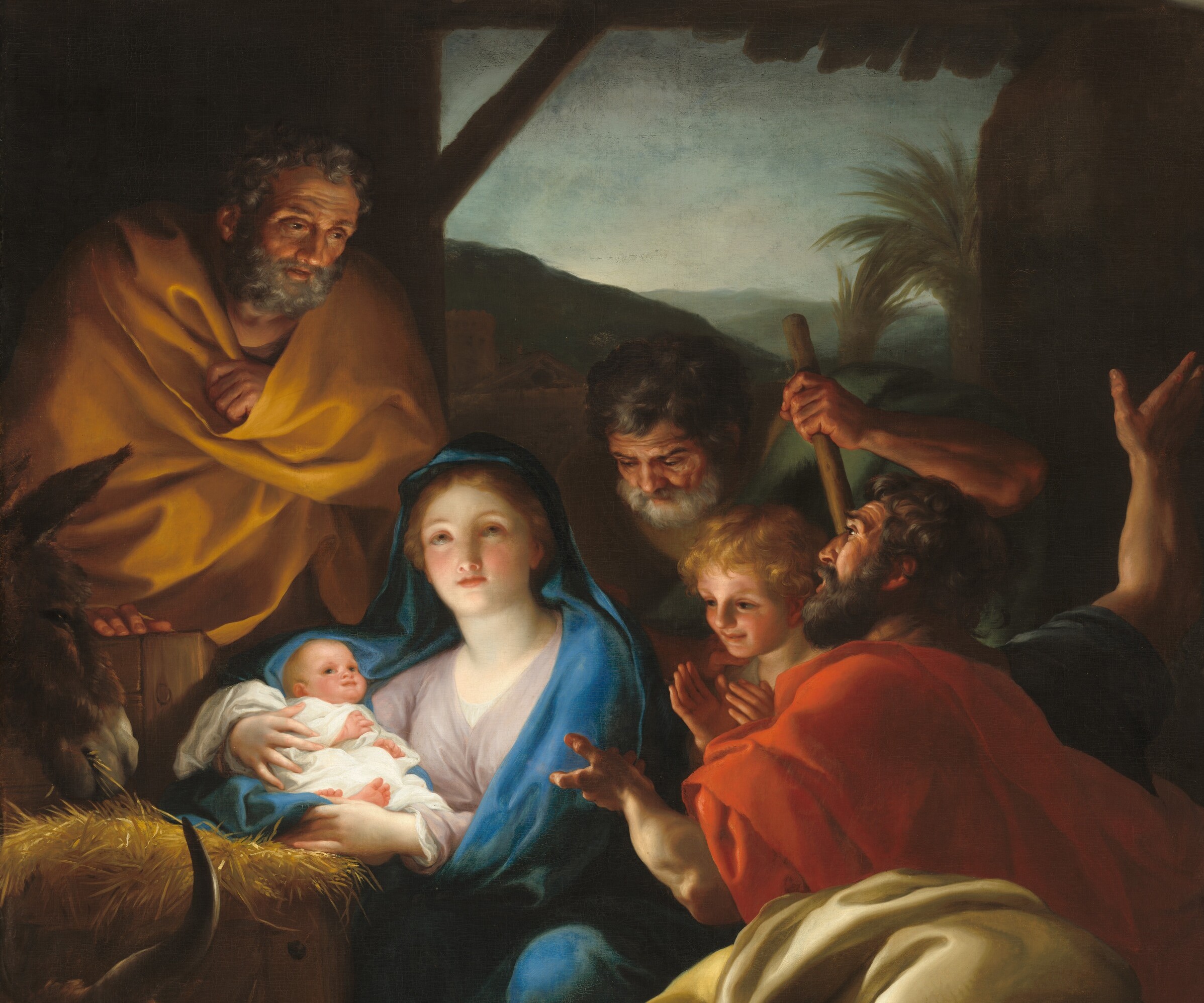
The Adoration of the Shepherds (cropped) : German Painter: Anton Raphael Mengs: 1765
Editorial
From time to time, The Queen will republish Editorials or create new Editorials on various topics.
Return to The Queen: Articles
God’s Ways Are Not Our Ways
But God’s ways are not our ways, and He often confounds the wisdom of the wise. He knew that His chosen people had, for the most part, been looking for an earthly king, a Messiah who would restore the power and prestige of the reign of David and Solomon. Most of them expected a warrior who, like Judah the Machabee, would drive the enemies of Israel out of the land that God had given to His people.
The prophets that God had sent, especially Isaiah, had hinted strongly that the Messiah would be a “man of sorrows,” that He would take upon Himself the sins of His people, that He would be like the sacrificial lamb led to the slaughter.
But, for the most part, these hints were . . .
. . . ignored or explained away as unworthy of the Messiah-to-come. People continued to believe in the importance of power and wealth. To them, these were signs of God’s blessing, and there was no possible way for them to accept the concept of a Messiah who would be lowly and poor, who would come among us as an ordinary-looking child, born in a stable in a town like Bethlehem.
Impossible to Believe
Above all, they found it impossible to believe that the Messiah would be subject to suffering and death, that the long-awaited redemption would be brought about by death on the cross.
Nowadays, we have the advantage of many centuries of Christian tradition. We accept on faith that the Messiah came to us as He did: in poverty and rejection by so many of His own. To us, there is nothing too startling in the thought of Christ being born in a stable, leading a fairly ordinary life similar to the lives of the people of His time. We have even grown accustomed, by the grace of God, to see that a redemption through suffering and death was the way chosen by God, and therefore the way that is best for us.
Like the people of the time of Christ, we too have occasional difficulty in accepting the full import of our redemption. How often do we ask the question: “If God is good and wise and loving, why is there so much suffering in the world? Why are there tragedies like mass starvation and plagues? Where is the goodness of God in all this ‘
Christ gave us no direct answers to these questions and others like them. He simply gave us the example of His own life and reminded us that, “Greater love than this no one has than to lay down his life for his friends.“
This love is worth considering as we look into the Christmas crib. The images will remind us of the story of Bethlehem, a story of how God wished to attract our love for Him by coming to us as a newborn child.