The Echo of God: Mary’s Praise and the Transformation of the Human Heart
Fr. Felix Phiri, SMM
The Echo of God: Mary’s Praise and the Transformation of the Human Heart
T his conference represents a Marian retreat centered on praying . . .
. . . “with Mary, in Mary, through Mary, and for Mary,” emphasizing that the purpose of the day is not primarily intellectual instruction but interior experience. The opening prayer . . . the Little Crown of the Blessed Virgin . . . draws on Revelation 12’s image of the woman crowned with twelve stars, structured as three “crowns”: excellence (Mary’s virtues and divine motherhood), power (her royal and mediating role in salvation history), and goodness (her compassion toward sinners, the suffering, and the dying).
The second half of the reflection develops a meditation on the biblical meaning of the “heart.” In Scripture, the heart is not merely emotion but the center of the human person, the place of desire, loyalty, and moral orientation . . . what shapes either good fruit or evil actions (Luke 6:45; Mark 7). The heart is also closely linked with the eyes and ears: what one sees and hears shapes obedience or resistance to God. A divided heart, influenced by many “lords” such as wealth, power, or ego, contrasts with the single-hearted obedience demanded by the Shema (“The Lord is one”). Mary is presented as the model of this unified heart . . . completely ordered toward God, perfectly receptive to His Word, and fully cooperative with the Holy Spirit.
In this light, the Immaculate Heart of Mary is understood as the perfectly purified human heart in total relationship with God . . .fully obedient to the Father, receptive to the Son, and fruitful through the Holy Spirit. Her responses in Scripture (“Let it be done to me according to your word,” and “My soul magnifies the Lord”) reveal her as the “echo of God,” where every honor given to her returns as praise to God. The retreat concludes by inviting participants to examine their own hearts: who or what is their true “lord,” and whether their hearts are unified in God or divided among competing loyalties.
Listen to this Meditation Media.
The Echo of God: Mary’s Praise and the Transformation of the Human Heart
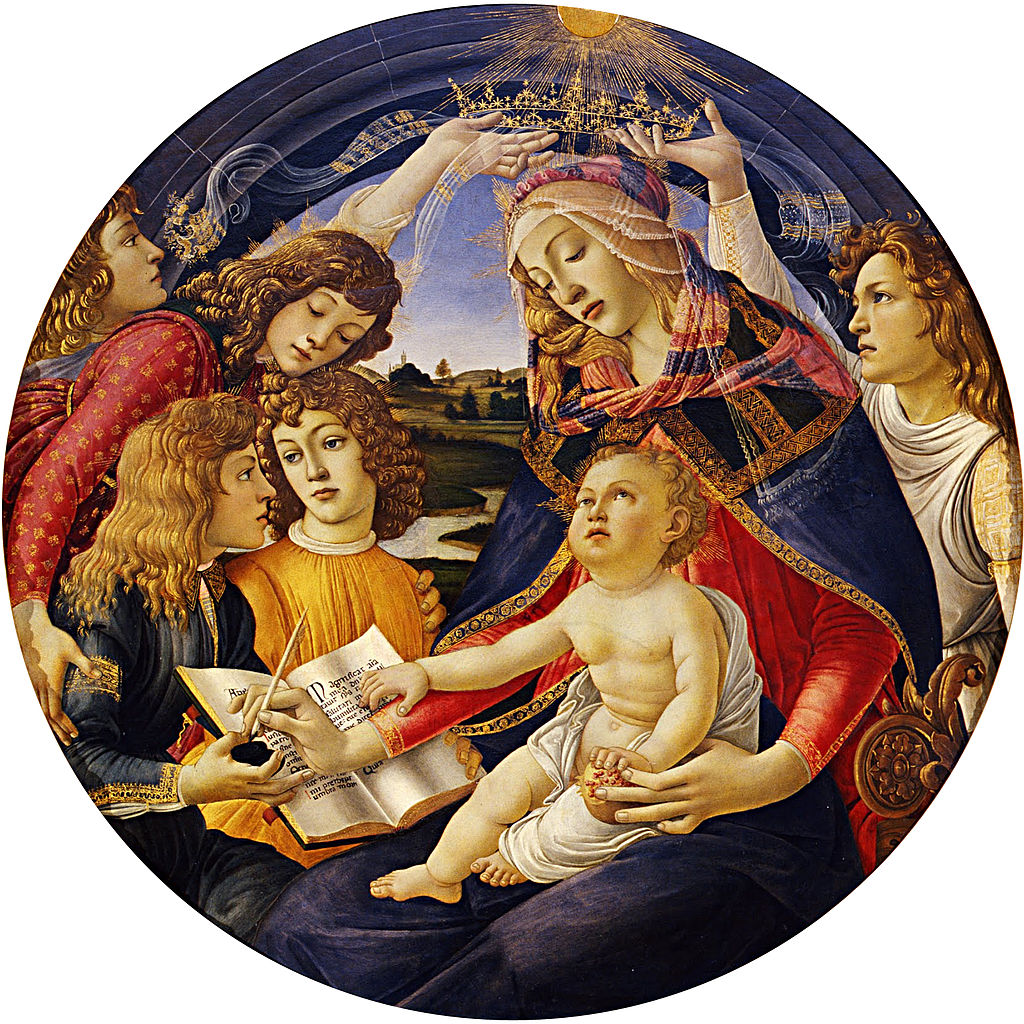
Madonna of the Magnificat: Italian Painter: Sandro Botticelli: 1481
This circular painting is by the Italian Renaissance painter Sandro Botticelli. Some know this painting under the title the Virgin and Child with Five Angels. In the painting, we see Our Lady writing the Magnificat with her right hand. Two angels are crowning Our Lady, with the Christ child on her lap. It now resides in the gallery of the Uffizi, in Florence.
Note: we often see a smaller version of this painting; focusing on the Crowning of Our Lady. This is the full painting.
Return to Meditation for the Week
Why was this image selected:
Mary is shown writing the Magnificat, embodying the idea that everything in her life returns as praise to God . . . an artistic expression of her being the “echo of God.”
The Echo of God: Mary’s Praise and the Transformation of the Human Heart