Changing the I to We
Fr. J. Patrick Gaffney, SMM
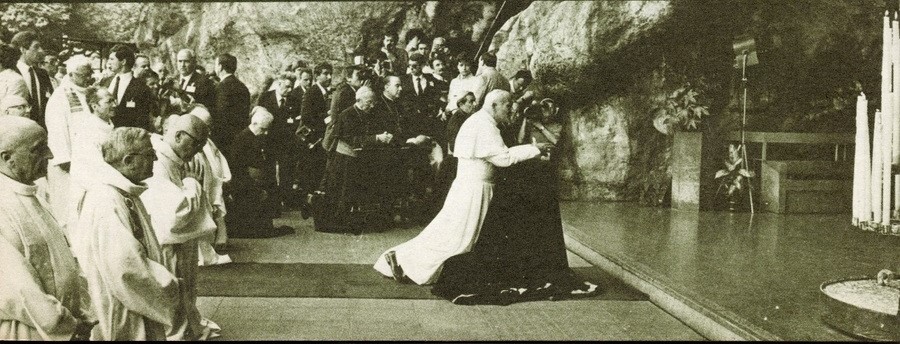
On March 25,1983, the Church witnessed a rare event: “a pastoral expression of collegiate communion.”
This article is the first instalment of a two-part article which appeared in the English Edition of L’'Osserva-tore Romano, April 16, 1984. Father Gaffney served as a Professor of Theological Studies at St. Louis University
Changing the I to We
O n the Feast of the Annunciation of the Lord . . .
. . . on March 25, the Act of Entrusting to Our Lady was proclaimed by all the bishops of the Church in union with the Supreme Pastor, the Bishop of Rome. Not only does this constitute one of the supreme moments of the Jubilee Year of Redemption but should be considered as one of the significant events of the Church since the Second Vatican Council.
Whereas at Fatima on 13 May 1982, His Holiness Pope John Paul II, “as Supreme Pastor of the entire Church,” first prayed this Act of Entrusting and did so united spiritually with his brother bishops, he now invited each bishop of the Church to pronounce this solemn consecration with him. The “I” of the prayer at Fatima has been intentionally changed to “We.” The Church is witnessing a rare event: a pastoral expression of collegiate communion. This event calls for the attention and sincere participation of all the faithful. It is a joyful duty, therefore, to examine this collegiate pronouncement in order to discover its profound meaning.
WORLD SITUATION
First of all, the Holy Father stresses the context in which this Act is professed. Through a brief yet profound survey of the serious world situation, the Act of Entrusting calls us to ponder our deep need for reconciliation, for Redemption.
In vivid terms, the crisis condition of the world is described throughout the formula: “the struggles between good and evil, between light and darkness which afflict the modern world”; it speaks of “every evil which the spirit of darkness is able to awaken and has in fact awakened in our times, in the heart of man and in his history.” Before listing the particular anxieties which so plague modern society, the document speaks of “the menace of evil, which so easily takes root in the hearts of the people of today and whose immeasurable effects already weigh down upon our modern world and seem to block the paths toward the future.” The Act closes with a litany of the evils of our times from which we beg to be delivered:
Evils Facing of Our Times from Which We Beg to be Delivered
“Famine and War,” “nuclear war, incalculable self-destruction, every kind of war,” “sins against the life of man from its very beginning,” “hatred and the demeaning of the dignity of the children of God,” “every kind of injustice in the life of society, both national and international,” “readiness to trample on the commandments of God,” “attempts to stifle in human hearts the very truth of God,” “the loss of awareness of good and evil,” “sins against the Holy Spirit.”
The Act of Entrusting is set within this context of the dangers which threaten modern man. That this is the background against which we are to view the consecration is also clear from the Holy Father’s homily at Fatima on 13 May 1982, when he explained its meaning. In moving terms, he describes how he reads the motherly call to penance and conversion uttered by our Lady at Fatima “with trepidation in his heart, because he sees how many people and societies . . . how many Christians . . . have gone in the opposite direction to the one indicated in the message of Fatima. Sin has thus made itself firmly at home in the world and the denial of God has become widespread in the ideologies, ideas and plans of human beings . . .
My Heart is Oppressed
My heart is oppressed when I see the sin of the world and the whole range of menaces gathering like a dark cloud over mankind” (n. 11). With his view of the world situation, the Vicar of Christ speaks of “the deliberate blotting out of God from the world of human thought. The detachment from him of the whole of man’s earthly activity. The rejection of God by man. In reality, the eternal salvation of man is only in God. Man’s rejection of God, if it becomes definitive, leads logically to God’s rejection of man (cf. Mt 7:23; 10:33), to damnation” (n. 7). In strong language, the Chief Shepherd speaks of being “a wit-ness to the immensity of human suffering, a witness to the almost apocalyptic menaces looming over the nations and mankind as.a whole . . . of the evil that is spreading throughout the world and menacing the individual hu-man being, the nations and man-kind as a whole. . .” (n. 11).
By no means is the Act of Entrusting a pessimistic document; in no way does it lack the firm belief in the eschatological victory of the
Redemption by the Lord which infinitely exceeds the power of evil. As the Apostle Paul does in the fifth chapter of Romans, so too John Paul speaks of the evils of the world only to proclaim that definitive victory over sin is found in the Heart of the Redeemer “in the saving Love that is always stronger, always more powerful than any evil” (Act). The Holy Father, however, is realistic and does not fall into the trap which so besets modern man and intensifies the evil of the day: the denial of sin, the denial of hell, the denial of guilt, the denial of the need for repentance and conversion.
The Act makes it clear that there is no such thing as self-redemption. The grace of God, his free merciful love is needed. In no way can man pull himself —by his own bootstraps of the mire he has created by sin. “The eternal salvation of man,” firmly states the Holy Father, “is only in God.” In an age of nuclear arms buildup, of ever more strident threats by su-perpowers, of a materialistic world which has so decreased its atten-tion to God, the Holy Father can-not and does not ignore the seri-ousness of the situation. In fact, it is only when, like Pope John Paul, we let the deep anxieties of our age penetrate us, that we can fully understand the need for penance and conversion and the relevance, therefore, of the Act of Entrusting.
Man searching for peace out-side of God, yearning for fulfilment through the idols of this world yet becoming more frustrated as his own efforts make him sink deeper and deeper into the mire: it is only in this context that we can understand the meaning of the Act of Entrusting. For through this consecration the Church ever more eagerly opens herself to the only answer to the ills of modern society: Jesus, the Son of Mary.
THE RESPONSE
Second, it is, therefore, in the framework of the serious evils of the times that the Act of Entrusting is to be studied. The anxieties of this present age constitute the question of mankind. What is the response? This is the core of the Act. The collegiate response of the bishops is twofold.
1) Victory has been achieved in principle over all the evils of this world, over all sin, through the Redemptive Life, Death and Resurrection of Jesus the Lord (i.e. the objective redemption).
2) This eschatological Victory must be implemented by our total, lived-out acceptance of this gift of Love, the Redemption, which demands repentance and conversion (i.e. the subjective redemption).
The collegiate Act of Entrusting stresses that both elements— which constitute the essentially single act of redemption the role of the New Eve, Mary: otherwise, they would not be in conformity with the Scriptures as lived within the Church, “the pillar and bulwark of the truth” (1 Tim 3:15).
We will consider both these elements of the Act of Entrusting with their Marian dimensions.
1) The Victory of the Redemption. The principal theme of the Act of Entrusting is the triumphant chant of Paul: “Thanks be to God who gives us the victory through Our Lord Jesus Christ” (1 Cor 15:57). The inexhaustible power of the redemption is underlined by Pope John Paul both in his letter to the bishops inviting them to this collegial act of consecration, and in the words of the Act itself. In his short letter to his brother bishops, the Holy Father four times refers to this power of the Redemption and five times again in the formula of the consecration.
The Feast of the Annunciation of the Lord is itself, says the Pope in his letter to his brother bishops, “a further stimulus in order that in the context of this Jubilee, in the face of the threats to contemporary humanity which have their roots in sin, there be made a more intense appeal to the power of the Redemption.”
The victorious Redemption wrought by Jesus is our response to the threatening situation of the world, for in the pierced Heart of Christ is found the source of pardon, of reparation, of peace. The Holy Father accentuates this point in his Fatima homily: “By the power of the redemption, the world and man have been consecrated. They have been consecrated to him who is infinitely Holy. They have been offered and entrusted to Love itself, merciful Love” (n. 9). In his letter to the bishops, the Pope speaks of the fact that conversion can only be “in the profession of the infinite salvific power of the Redemption.”
Salvific Power of the Redemption
The “salvific power of the Redemption” which is “saving Love” is “always stronger, always more powerful than any evil… no sin of the world can ever overcome this Love” (Fatima Homily n. 10). The Holy Father, therefore, “rejoices with hope” (Fatima Homily n. 10) for he sees in the power of Christ’s consecration to the Father on behalf of sinful man, the power which “overcomes every evil that the spirit of darkness is able to awaken” (Act). Both the Pope’s homily at Fatima and the Act of Entrusting conclude on the note of victory: the homily recalling that although “at present the ‘former things’ are still in existence,” constituting “the temporal setting of our pilgrimage . . . we look towards “him who sits upon the throne and who says: ‘Behold I make all things new’ ” (Rev. 21:5).
The conclusion of the Act of Entrusting is the cry from the heart of the Supreme Pastor which is repeated by all the bishops throughout the world: “Let there be revealed once more in the history of the world the infinite saving power of the Redemption: the power of merciful Love! May it put a stop to evil! May it transform our consciences! May your Immaculate Heart reveal for all the light of Hope!”
In the face of the crises which brood over us as we come to the end of the second millennium, the successors of the Apostles call upon us to raise our eyes to the Triumph of the Cross. Infinite Love has sent his only Son so that through his Life, Death and Resurrection, we may have victory over all the sins of our age, over death, over all the powers of evil. In this valley of tears, we know that we are loved, we are redeemed, and in the infinite power of that Love this world can be transformed.
EVANGELICAL MARIAN DIMENSION
Yet the understanding of Redemption as God has willed it would not be complete if the cooperation of the “Mother and Hand-maid of the Lord” (Act) is forgotten. The victorious Redemption by Christ— which is the light of hope in the midst of the darkness of our times has an evangelical Marian dimension.
The Role of Mary in the Victory Over Sin
The Magisterium is the “servant” of the Word of God made up of Sacred Tradition and Sacred Scripture (cf. Second Vatican Council, Constitution on Divine Revelation, n. 10) and: therefore, speaks of the role of Mary in the victory over sin. For to omit this from our vision of the Redemption would be to tear out of the Bible the infancy narratives of Matthew and Luke, to gloss over John’s profound insights into the role of Mary at the Marriage Feast of Cana (cf. Jn 2:1-11) and at the foot of the Cross (cf. Jn 19:26-27); it would necessitate ignoring the fact that in obedience to Sacred Scripture, all generations of the Spirit-filled Body of Christ has proclaimed her “blessed” (cf. Lk 1:48).
The Act of Entrusting, therefore, takes cognizance of this unique role of Mary in our redemption. For she is “the Immaculate One, the first marvel of the Redemption” (Pope John Paul, General Audience of 7 December 1983, L’Osservatore Romano, English edition, 12 December 1983, p. 1), preservatively redeemed, “created immaculate to be better able to act on our behalf.
The fullness of grace allowed her to fulfil perfectly her mission of collaboration with the work of salvation: it gave the maximum value to her cooperation in the sacrifice. When Mary presented to the Father her Son nailed to the cross, her painful offering was entirely pure. . . It is for us sinners, that is, for all of us, that she received an exceptional grace” (ibid.). Her redemption through the foreseen merits of her Son is, therefore, so that she may truly be the “Handmaid of the Redeemer” in his work of salvation.
How does Our Lady fulfil this role in the objective redemption? It is her faith, her fiat which is stressed by the Holy Father. In the Angelus message of the Second Sunday of Advent of last year, the Holy Father echoes the Scriptures and the constant teaching of the Church when he said: “The world’s salvation is linked to her faith” (L’Osservatore Romano, English edition, 12 December 1983, p. 2). For Mary’s faith her response to God’s call at the Annunciation is not only in her own name, but is spoken for all of us. She represents mankind yearning for redemption, and as Daughter Zion actively and responsibly accepts God’s offer to love us, to heal us, to redeem us.
As the Holy Father stated in the same Angelus address: “Just as in Christ Jesus, the Word of the Father, all of God’s saving acts are summed up, so in Mary’s response the adherence of faith of God’s people and all its members is summed up and reaches completion . . . Mary’s response is personal but it also has a community meaning.
Mary’s Response
In her ‘yes’ flows the faith of ancient Israel and there is begun the faith of the Church. Her fidelity to the Lord, througha solidarity of grace, is a blessing for all who believe.” The Act of Entrusting, therefore, speaks of Mary “who in the fullest way obeyed the divine call” (n. 2).
Mary’s “yes” is necessary only because so willed by God who in the economy of salvation wants a woman to cooperate in the Redemption by her “corporate” consent, by her representative, salvific fiat. Through this obedience of faith, Mary becomes in a special way the “dwelling place of the Most Holy Trinity” (Fatima Homily n. 4), she is indissolubly united to the Triune God as Daughter of the Father, as Mother of the Son, as Temple of the Holy Spirit (cf. Second Vatican Council, Constitution on the Church, n. 53). She therefore cooperates by her faith to the inbreaking of Redemption into our fragmented world.
“Rightly, therefore,” states the Second Vatican Council, “the Fathers see Mary not merely as passively engaged by God, but as freely cooperating in the work of man’s salvation through faith and obedience. For as St. Irenaeus says, she ‘being obedient, became the cause of salvation for herself and for the whole human race’. . . This union of the Mother with the Son in the work of salvation is made manifest from the time of Christ’s virginal conception up to his death… (Mary) lovingly consenting to the immolation of this victim which was born of her” (Constitution on the Church, nn. 56-58).
Mary’s salvific “yes” . . .
. . . is the foundation of her Motherhood of the Church. For by this faith, she truly cooperates in our rebirth, in our new life in Christ. For us, she is “wholly united to the redeeming consecration of (her) Son” (Act), She is truly our Mother for through her our Redemption has come to be, and through her faith, she speaks the “yes” of all mankind to the Redeemer’s call, a “yes” which God wills as necessary in the present order of redemption.
Mary’s Faith at the Climax of Redemption
The Holy Father underlines faith of Mary at the climax of redemption, the Sacrifice of the Cross. “On the Cross, Christ said: ‘Woman, behold your son!’ With these words he opened in a new way his Mother’s Heart . . . the Immaculate Heart of Mary, opened with the words ‘Woman, behold your son!’ is spiritually united with the Heart of her Son opened by the soldier’s spear. Mary’s Heart was opened by the same love for man and for the world with which Christ loved man and the world, offering himself for them on the Cross until the soldier’s spear struck that blow’ (Fatima Homily,
n. 8).
The fiat uttered by Mary at the Annunciation deepens with each moment, reaching an unimaginable depth of surrender—in our name—as she actively consents to her consecration of the world by her dying Son, whose “pierced Heart became a sign of the redemption achieved through the death of the Lamb of God” (Fatima Homily, n. 8).
The solid theological foundation of the Act of Entrusting is, then, the eschatologically victorious Redemption accomplished by Jesus the Lord who chose Mary to be his Mother and Companion in work of redemption. It is on this firm rock of the Word of God that the collegiate consecration is built.
2) The Implementation of the Victory. The entire history of man-kind always and everywhere stands under God’s forgiving, victorious, redemptive Love in Christ Jesus. This is the reality of the human situation. “The world and man have been consecrated” (Fatima Homily, n. 9). Pope John Paul stresses this redemptive Love which truly affects us and which is the very fabric of the history of salvation. In Christ Jesus we know that this effective offer made to the freedom of man is irreversible; it is the permanent, dynamic call to fullness of life in Christ Jesus, empowering us to respond in freedom to God’s loving, redemptive presence.
There is, however, the stark reality that man may refuse the redemptive love of Christ and try to find salvation in the multiple idols of modern times: power, prestige, wealth, unbridled pleasure-seeking, despair, an inordinate concern over one’s health and future as if there were no loving God.
Redemption by Christ
To put it positively, the Redemption by Christ is not to be refused but through grace is to be accepted in faith, through the total surrender on every level of personality to the fullness of reality, Christ Jesus our Redeemer.
Modern man attempts to live in an unreal world as if redemption in Christ Jesus had not occurred or as if salvation is through someone or something else or is to be found in ourselves. Especially in the midst of today’s world, therefore, the victorious Redemption in Christ Jesus —the only Name by which we must be saved (cf. Acts of Apostles 4:12)— must be loudly proclaimed, lovingly and joyfully accepted.
(To Be Concluded)
M1984.07