Freedom Through Holy Slavery
Fr. Roger Charest, SMM
HOLY SLAVERY: . . .
At the end of his treatise on True Devotion to Mary, . . .
. . . which he probably wrote in the year 1713, St. Louis de Montfort had written out a formula of consecration which was lost along with the last pages of his manuscript. It is replaced today by another formula of Consecration taken from a manuscript written some ten years previously and called, The Love of Eternal Wisdom.
This latter book, as it has been pointed out, was “the fruit of conferences given by Montfort to Seminarians, during his stay in Paris, between 1702 and 1704.” In other words, the formula of consecration, which is in use today, and known as the de Montfort Consecration, is one he wrote out when he was still a very young priest, barely three years after his ordination, and not the one which he had written at the end of his True Devotion to Mary.
The formula of consecration is dramatic in tone and seems to revel in words such as, “glory,” heavenly “court” and “according to your good pleasure,” all expressions that were in use in the time of King Louis XIV, the “Sun King.” Here is how Fr. de Montfort phrased it: “In the presence of all the heavenly Court, I choose you today, as my Mother and Mistress. I deliver and consecrate to you, as your slave, my body and soul, my goods, both interior and exterior, and even the value of all my good actions, past, present and future, leaving to you the full right of disposing of me and all that I have, without exception, according to your good pleasure, for the greater glory of God, in time and in eternity.”
Fr. de Montfort’s later writings are devoid of this type of dramatization. At the end of his Missions (from 1706-1716), he would ask people to sign “Covenants with God,” which were so much simpler in tone, such as: “I give myself entirely to Jesus Christ through the hands of Mary to carry my Cross after Him all the days of my life.”
ROOTED IN BAPTISM
These “Covenants with God” as well as the “Consecration of oneself to Jesus through the hands of Mary” find their source in Baptism.
They are but an expression of the vows of Baptism. Their common goal is fidelity to Christ. Like the “Covenants with God,” the formula of Consecration taken from The Love of Eternal Wisdom is addressed to Jesus Christ, “that I may be more faithful than I have ever been before.” All refer also to the Cross of Jesus Christ. In fact, the words are the same in all of them: “I give myself entirely to Jesus Christ, to carry my Cross after Him all the days of my life.”
In conformity with a spiritual trend, which was already centuries old in his day, Montfort uses the word “slavery” to express this total gift of self—a term which in human societies best describes total dependence of one person on another. It is interesting to point out here, that our own Pope John Paul Il does not seem to be the least disturbed by this outmoded formulation. In a recent interview, he commented on this very subject.
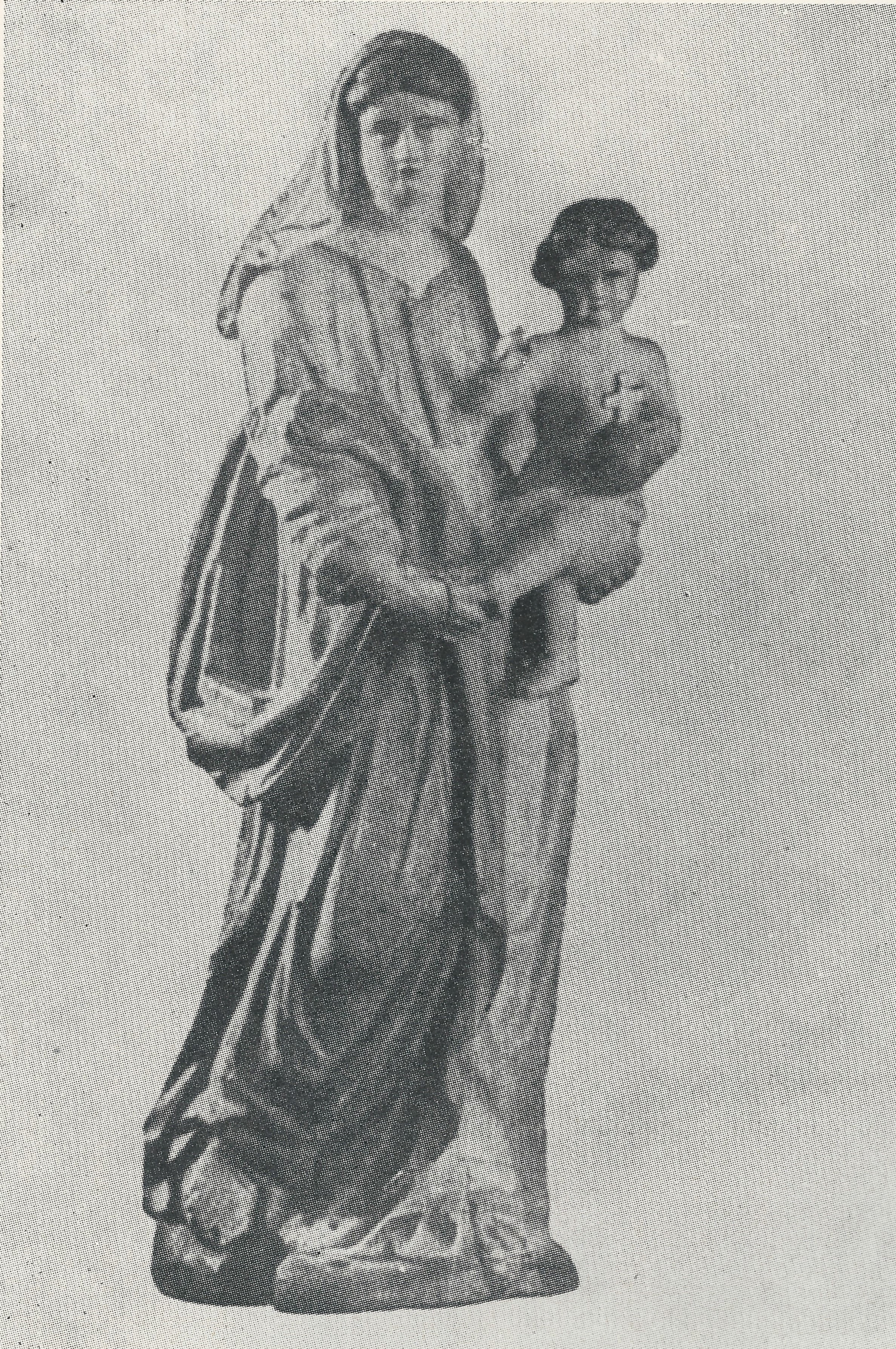
Our Lady of Saint Amand
I n the year 1714, St. Louis de Montfort gave a mission at St. Amand where the people were credulous and superstitious.
They attributed sickness and other misfortunes to those of their number who were supposed to practice black magic. To overcome these difficulties, the missionary preached devotion to the Blessed Virgin and time proved the efficacy of his work for these troubles never occurred again. Tradition holds that, to assure their perseverance, St. Louis Mary carved this, his last statue which has always been preserved in that parish. Many affirm that they have received favors through the intercession of Montfort as a result of prayers said before this statue. One of several statues that Montfort carved.
Note
This image was taken from a hazy photo of the statue. It is the digital team’s prayer that someday modern pictures of his statues may be published.
Return to The Queen: Articles
Freedom . . .
“It is well known that the author of the treatise (on True Devotion) defines his devotion as a kind of ‘Slavery.’ The word may shock our contemporaries. Personally, I see no problem with it. I think that it is a kind of paradox that is often found in the Gospels, the words ‘holy-slavery’ signifying that we cannot make any greater gift than that of our freedom, the greatest gift we have received from God. For freedom is measured by the amount of love of which we are capable. That, I think, is what the author (St. Louis de Montfort) wanted to tell us” .
It is indeed paradoxical to consider our Christian faith as a form of slavery, since the Christian believer is supposed to be free to believe. In fact, Christ came to make us free, with the freedom of the children of God. Moreover, freedom is not only a God-given right, but part of our human makeup and a fundamental human tendency and aspiration.
It is true that we all must admit to our complete dependence on God, our Creator, on Whom we depend for our very existence. But this relationship of dependence is one of love, one based on the relationship of a child to its all loving Father, Redeemer and Sanctifier; a relationship to one Who is Himself Absolute Freedom; a relationship that calls for our being freed from “the cruel slavery” of the devil and the world, as St. Louis de Montfort would put it, in order to belong to God Alone.
Thus, the consecration of Holy Slavery to Jesus through Mary, like Baptism, leads us to this spirit of freedom that increases as we grow in the spiritual life. It matters little whether certain centuries in the Church stressed our dependence on God, while other centuries, as in our own day, the stress is on freedom: what doesn’t change is, as Pope John Paul Il put it, that “freedom is measured by the amount of love of which we are capable.”
As a Reminder Our Consecration of Holy Slavery
Referring to the practice of wearing little chains, as a reminder our consecration of holy slavery, Fr. de Montfort wrote: “These little chains are a wonderful aid in recalling the bonds of sin and the slavery of the devil from which Baptism has freed him. At the same time, they remind him of the dependence on Jesus promised at Baptism and ratified when, by consecration, he renewed these promises” (T.D. #238).
One of the Effects of the Total Consecration
One of the effects of the Total Consecration, he assures us, is that Mary, “The Mother of fair love will rid your heart of all scruples and inordinate servile fear. She will open and enlarge it to obey the commandments of her Son with alacrity and with the holy freedom of the Children of God” (T.D. #215).
Apart from passing references, biblical quotations, etc., the Treatise on True Devotion to Mary is, a sense, a “spiritual biography” St. Louis de Montfort. Little wonder that Our Holy Father said, the interview mentioned above, that the True Devotion to Mary is one of those books which it not sufficient simply ‘to have read.’ I remember carrying it about with me for a long time, even into lime factory, which resulted in lovely cover being soiled with lime. I kept returning, time and time again, to certain passages. I soon discovered that I was dealing with something very fundamental . . . ”
INTERIOR DEVOTION
That the Holy Father was referring at this point, . . .
. . . was that the Montfort Consecration of Holy Slavery, reaches into the interior spiritual life and is not a mere exterior form of devotion. To quote Montfort himself: the essential of this devotion consists in the interior which it ought to form ” (T.D. #119) as the more recent translation puts it: “This devotion essentially consists in a state of soul,” a way life whose ultimate goal is to “conform, unite and consecrate us to Jesus Christ” (T.D. #120), Eternal and Incarnate Wisdom.
Fr. de Montfort realized that not everyone would understand, much less enter fully into this beautiful way of spiritual life. “It will not be understood in the same way by everyone,” he wrote. “Some—the great majority—will stop short at the threshold and go no further. Others—not many—will take but one step into its interior. Who will take a second step? Who will take a third? Finally, who will remain in it permanently? Only the one to whom the Spirit of Jesus reveals the secret. The Holy Spirit himself will lead this faithful soul from strength to strength, from grace to grace, from light to light, until he attains transformation into Jesus in the fulness of his age on earth and of his glory in heaven” (T.D. #119).
Earlier in his treatise, No. 55, the Saint had outlined for us the role of the Holy Spirit in this way of life. “If the elect, by the grace and light of the Holy Spirit, adopt the interior and perfect practice (of this devotion) they will see clearly that beautiful Star of the Sea, as much as faith allows . They will perceive the splendors of this Queen and will consecrate themselves entirely to her service as subjects and slaves of love . They will experience her motherly kindness and affection for her children. They will love her tenderly.
In all circumstances they will have recourse to her . they will surrender themselves to her, body and soul, without reserve, in order to belong entirely to Jesus.”
The Holy Spirit of Jesus, therefore, who is the author of truth and freedom, is the only one who can introduce us into this spiritual “inner sanctum” called Mary, in whom and through whom He has not only accomplished the work of the Incarnation but now continues to give us his greatest gift, the gift of the freedom of the Children of God, by which we can say “Abba, Father!”
Freedom Through Holy Slavery
Could it be this paradoxical spirit of “freedom through holy slavery that has attracted Pope John Paul Il to the Montfort way of spiritual life? At any rate, he sees “this ‘perfect devotion’ as indispensable for the one who wishes to give himself unreservedly to Jesus Christ and to the work of the Redemption.” The reason he gives for this is that: “Grignion de Montfort introduces us into the very heart of the mysteries on which our faith lives, and grows and bears fruit.
“The more my spiritual life was centered on the reality of the Redemption, the more abandoning myself to Mary, in the spirit of St. Louis de Montfort, appeared to me to be the best way to share fully and effectively in the reality, in order to draw out for myself, and to share with others, its unspeakable benefits.”
If any of our readers still wonder where this modern day, free-spirit-Pope, John Paul Il by name, acquired in great measure his very special Marian devotion, he will tell you: “This (Montfort’s) Marian devotion . has since remained a part of me. It is an integral part of my interior life and of my spiritual theology.“