FINDING MARY IN THE SCRIPTURES – Part VIII: The Christmas Event
Fr. James McMillan, SMM
FINDING MARY . . .
The Christmas Event
The story of Christ’s birth in the stable of Bethlehem is one that is known all over the Western world.
And the story of Our Lady’s role is one that is equally well-known. For if a child is to be born, his story cannot be told without reference to his mother.
St. Luke, in his gospel, gives the setting for the story of the birth of Christ: “It happened that a decree went out at this time from the emperor Augustus, enjoining that the whole world should be registered. All must go and give in their names, each in his own city; and Joseph, being of David’s clan and family, came up from the town of Nazareth in Galilee, to David’s city in Judea, the city called Bethlehem, to give in his name there. With him was his espoused wife Mary, who was then in her pregnancy . . . “.
The gospels rarely depict the inner feelings, the emotions, the thinking of the characters that they portray. St. Luke says nothing about the suffering and anguish of an entire population being uprooted, forced to go from their homes to their “own city” in order to register for purposes of world-wide taxation. There must have been unbelievable confusion and endless crowding on the roads. Our Lady and St. Joseph shared in these hardships, for they too were uprooted from their home in Nazareth and forced to travel to their “own city” of Bethlehem.
“And it was while they were still there,” continues St. Luke, “that the time came for her delivery. She brought forth a son, her first-born, whom she wrapped in his swaddling clothes, and laid in a manger, because there was no room for them in the inn.”
Many Have Tried to Convey what Must have Been the Feelings of Christ’s Mother and Foster-Father
Countless poets, painters, writers and musicians have tried to convey what must have been the feelings of Christ’s mother and foster-father while the events surrounding the birth of the Redeemer were taking place. And no doubt they will continue to do so until the end of time, for they sense, as do we all, that the birth of Christ has incalculable importance for the human race.
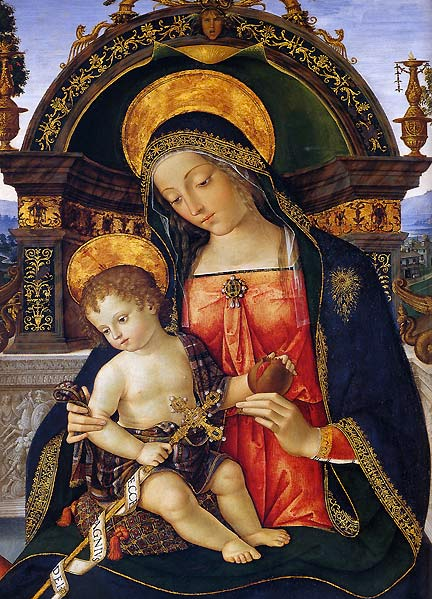
Madonna and Child: Italian Painter: Pinturicchio (1454-1513)
Also known as Pintoricchio or Pinturicchio. His formal name was Bernardino di Betto, also known as Benetto di Biagio or Sordicchio.
Return to The Queen: Articles
A note from the Editor of The Queen: The Queen has previously published several series on “Mary in the Gospel of . . . “. Use this link to view these series.
Note #2: This is the eighth article in this series. The previous articles appear here.
But St. Luke, the only gospel writer to narrate the actual birth of Christ, concerns himself only with the basic facts: “She brought forth a son, her first-born, whom she wrapped in swaddling clothes, and laid in a manger.
One can hardly imagine our Blessed Lady not reflecting back to the events of the Annunciation at a time like this.
The angel Gabriel had told her of the greatness of her child: “ men will know him for the Son of the Most High; the Lord God will give him the throne of his father David, and he shall reign over the house of Jacob eternally; his kingdom shall never have an end . . . this holy offspring of thine shall be known for the Son of God.”
It is as if God were Giving Our Lady the First Taste
But here in a stable in Bethlehem there is no trace at all of power and majesty. There is none of the awesome thunder and lightning that the Jewish people had always associated with the presence of God among us. It is as if God were giving Our Lady the first taste of what it means to be the Mother of Sorrows.
The angels were not, as we sometimes like to imagine, hovering over the crib of the Christ child in Bethlehem. Had there been, we can be sure that St. Luke would have mentioned them. Instead, they were out in the fields where the shepherds were keeping night watch over their flocks.
The Lord . . .
“And all at once,” St. Luke tells us, “an angel of the Lord came and stood by them, and the glory of the Lord shone about them, so that they were overcome with fear. . And a multitude of the heavenly army appeared to them at the angel’s side, giving praise to God and saying, Glory to God in high heaven, and peace on earth to men that are God’s friends.”
When the angels left them, the shepherds said to one another: “Come, let us make our way to Bethlehem and see for ourselves this happening which God has made known to us.” They found Mary and Joseph, with the child lying in the manger.
They recounted to Mary and Joseph the events that had occurred: how the angel had appeared to them and told them: “This day, in the city of David, a savior has been born for you, the Lord Christ himself.”
. . . Shone about Them
The gospel tells us that all who heard this story were full of amazement. “But Mary treasured up all these sayings, and reflected on them in her heart.” St. Luke does not tell us what these reflections were, but we can be sure that Our Lady took the coming of the angels to be a sign from God, a sign that would reassure her that her son was indeed the Messiah, the Son of God.
In a sense, she did not need this added reassurance. She had already shown that her faith in God was complete and total, with no wavering at all. Still, she was a daughter of Israel, a Jewish girl brought up in the Scriptures. She knew of the great prophesies about the coming Messiah, and she also knew that her people had always associated the coming of God with magnificent and terrifying manifestations of power and glory, as He did on Mount Sinai when He spoke to Moses.
So, among other reflections there at the crib, she undoubtedly thanked God for this extra sign that the Lord was indeed with her.
The Bible . . .
The gospel makes no mention of how long the Holy Family stayed in the stable, or for that matter, how long they stayed in Bethlehem itself. We do know that eight days after the birth of Christ, He was circumcised in accordance with the law of Moses, probably by St. Joseph himself, since at the time it was customary for the father to perform this rite. It was at this ceremony that a boy-child was given a name: “He was called Jesus, the name which the angel had given him before ever he was conceived in the womb.”
Forty days after His birth, Christ was in Jerusalem for the ceremony of His presentation in the temple and for the ritual purification of His Mother. There was a sacrifice that they had to offer to God: a pair of turtle-doves or two young pigeons. It was in the temple that they met Simeon and Anna, the prophetess. Both recognized the Child to be the promised Messiah.
Simeon said to Mary: “Behold, this child is destined to bring about the fall of many and the rise of many in Israel; to be a sign which men will refuse to acknowledge . as for thy own soul, it shall have a sword to pierce it.”
. . . Tells Us
We must remember that God revealed His plan of salvation only little by little. He did not tell the human race everything that was going to happen, or how that plan was to work out. And of course this included our Blessed Lady as well. The angel Gabriel had given her few details about how her Son was to redeem the human race. She knew and believed that her Son was the Messiah, the incarnate Son of God. But, at this point in her life, she knew nothing about how the redemption was to come about.
So, the events leading to Bethlehem, the birth of Christ in the stable, the coming of the shepherds, and above all the prediction of Simeon would have left her with a great number of things to “ponder in her heart.” By this time she was able to see that the Messiah did not intend to come as a great king and conqueror, to hold earthly power, to set Himself up in the place of the emperor Augustus.
And she had no idea of what was yet to come. She only knew that her faith in God and His promises was something she had to nourish and make grow. She was, with the grace of God, preparing herself to stand at the foot of the Cross.