FINDING MARY IN THE SCRIPTURES – Part VII: The Visitation
Fr. James McMillan, SMM
FINDING MARY . . .
The Visitation
St. Luke’s account of the visit of the Blessed Virgin Mary . . .
. . . to her cousin St. Elizabeth is one that tells us a great deal about our Blessed Lady and the part that she was to play in the redemption of the human race.
The event took place a little while after the angel Gabriel had announced to her that she was God’s choice to be the Mother of the Messiah, “In the days that followed,” St. Luke writes, “Mary rose and went with all haste to a town of Juda, in the hill country where Zachary dwelt; and entering in she greeted Elizabeth . . .
Nothing is Impossible with God
The reason for the visit is quite obvious from the story of the Annunciation. The angel had told her that Elizabeth was expecting a child, “that she who was barren is now in her sixth month, for nothing is impossible with God.” Our Lady was concerned for her aging relative, and thought to help Elizabeth through what looked to be a difficult time, And, no doubt, she wanted to see for herself this wonder that God had performed, and to rejoice with Elizabeth at the birth of her child.
“No sooner,” the gospel tells us, “had Elizabeth heard Mary’s greeting, than the child leaped in her womb; and Elizabeth herself was filled with the Holy Spirit; so that she cried out with a loud voice, Blessed art thou among women, and blessed is the fruit of thy womb.”
Up to this point in the narrative, there is no indication at all that Elizabeth even knew that Our Lady had been visited by the angel or that she was carrying the Son of God made man within her. St. Luke explains how she received her information: “Elizabeth herself was filled with the Holy Spirit.” The same Holy Spirit who overshadowed the Blessed Virgin at the Annunciation now inspired Elizabeth to recognize the Mother of the Redeemer and the coming of the long-awaited Messiah.
Elizabeth is lavish in her praise of Our Lady, wondering how she deserves to be visited by “the mother of my Lord.” She blesses Mary for her faith and proclaims that the “message that was brought to thee from the Lord
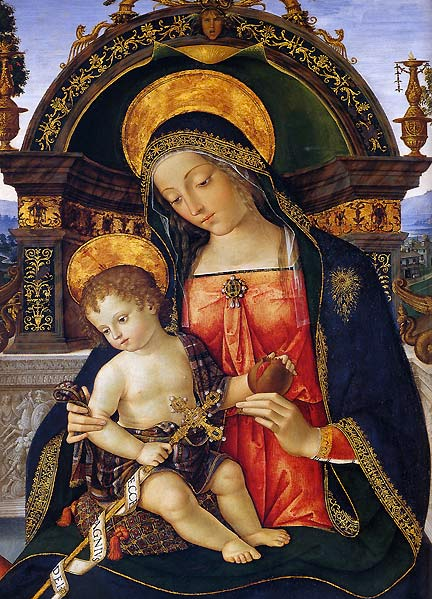
Madonna and Child: Italian Painter: Pinturicchio (1454-1513)
Also known as Pintoricchio or Pinturicchio. His formal name was Bernardino di Betto, also known as Benetto di Biagio or Sordicchio.
St. Luke’s account of the visit of the Blessed Virgin Mary . . .
. . . to her cousin St. Elizabeth is one that tells us a great deal about our Blessed Lady and the part that she was to play in the redemption of the human race.
Return to The Queen: Articles
A note from the Editor of The Queen: The Queen has previously published several series on “Mary in the Gospel of . . . “. Use this link to view these series.
Note #2: This is the seventh article in this series. The previous articles appear here.
shall have fulfillment.” The message, of course, is the message of salvation for all mankind.
The Story so far points to the Love Our Lady has for Us
. . . her elderly cousin, her care for her welfare, her own desire to bring Christ to others. It shows us the joy of St. Elizabeth at seeing her younger relative as “the mother of my Lord.” She tells Our Lady that it was the sound of her voice that made the infant in her womb leap for joy.
But all this praise from St. Elizabeth brings out a trait that we find in Our Lady all the way through the gospels: her self-effacement. She takes no praise for herself; she refers all the honor and glory to God. She bursts forth in an effusion of thanksgiving and praise in the hymn that we call the Magnificat.
It is the kind of a prayer that is known as a canticle, a song that depicts the glory of God and the wonders that He performs for the welfare of His human creatures. There are many such canticles in the Old Testament, but none so profuse in its praise and thanksgiving to God.
The Magnificat
“My soul,” said Mary, “magnifies the Lord, and my spirit rejoices in God my Savior.” Elizabeth had praised and blessed her, but Our Lady turns the praise and blessing to God: “He has looked graciously upon the lowliness of His handmaid; and behold, from this day forward all generations will call me blessed . . .” And the reason for that blessedness, Mary says, is “because He that is mighty has done great things to me, and holy is His name.”
The Magnificat continues in an ever-mounting crescendo of praise and thanksgiving to God. Our Lady stresses the mercy of God to those who fear Him: “He has wrought might with His arm, He has scattered the proud in the conceit of their heart; He has put down the mighty from their thrones, and has exalted the lowly; He has filled the hungry with good things, and sent the rich empty away,”
The prayer concludes on a note of exultation, the truth that all the children of Israel were waiting to hear: that God had remembered His promise to our ancestors, that He has fulfilled the covenant that He made with Abraham centuries before.
Like the Church, in its Divine Office, let us sing with Mary each day her song of praise and thanksgiving:
My soul proclaims the greatness of the Lord, my spirit rejoices in God my Savior, for he has looked with favor on his lowly servant,
From this day all generations will call me blessed: the Almighty has done great things for me, and holy is his Name,
He has mercy on those who fear him in every generation.
He has shown the strength of his arm, he has scattered the proud in their conceit.
He has cast down the mighty from their thrones, and has lifted up the lowly.
He has filled the hungry with good things, and the rich he has sent away empty,
He has come to the help of his servant Israel for he has remembered his promise of mercy, the promise he made to our fathers, to Abraham and his children forever.