FINDING MARY IN THE SCRIPTURES – Part XII: From the Crib to the Cross
Fr. James McMillan, SMM
FINDING MARY . . .
From the Crib to the Cross
This is how St. John, . . .
. . . the author of the fourth gospel, describes the scene of Christ’s death on Calvary: “,. . . His mother, His mother’s sister, Mary the wife of Cleophas, and Mary Magdalen, had taken their stand beside the cross of Jesus. And Jesus, seeing His mother there, and the disciple, too, whom He loved, standing by, said to His mother, Woman, this is thy son. Then He said to the disciple, . . . This is thy mother. And from that hour the disciple took her into his own keeping.”
These words of St. John have inspired poets, writers and painters from the very beginning of Christianity. The account is, like so many passages in the gospels, stark and spare in its simplicity. There is no mention of the dozens of details that would have embellished the narrative had St. John chosen to include them.
But what he did tell us brings out the point that he wished to stress: Our Lady’s strong and unconquerable faith in her divine Son.
Our Lady’s Strong and Unconquerable Faith . . .
He simply states that she, along with the other women, “had taken their stand beside the cross of Jesus.” There is no mention of anger at the outrage being perpetrated, of hysterics, of fainting, or of anything resembling the kind of near despair one would ordinarily expect from a woman watching her son die the slow and horrible death of crucifixion. We are rather left with the definite impression that it is her strength that is sustaining the others, including the apostle St. John.
Christian tradition has always depicted her in this scene as “The Sorrowful Mother.” And rightly so, of course. She was—and still is —a normal woman with the normal feelings of a mother. Certainly, she felt sorrow and grief: sorrow at her Son’s suffering and dying, and grief at the apparent failure of His mission as Messiah and Redeemer.
. . . in Her Divine Son
How could she have imagined that this, the execution of a rebellious slave, was the “hour” He had predicted, the supreme moment of His triumph over sin and death?
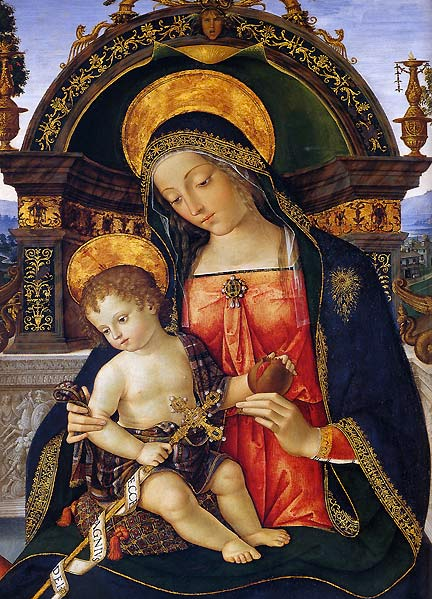
Madonna and Child: Italian Painter: Pinturicchio (1454-1513)
Also known as Pintoricchio or Pinturicchio. His formal name was Bernardino di Betto, also known as Benetto di Biagio or Sordicchio.
Return to The Queen: Articles
Note: This is the 12th article in this FINDING MARY IN THE SCRIPTURES series. The previous articles appear here.
She had been given some foreshadowing . . .
. . . of her Son as the “man of sorrows” according to the prophet Isaiah. She recalled the words of Simeon in the temple of Jerusalem that a sword would pierce her heart. And she must have heard from the apostles of His prediction that He as to be mocked and scourged and spat upon and put to death and would rise again on the third day.
She also Cherished What the Angel Gabriel had Told Her
But she also cherished what the angel Gabriel had told her at the time of the Incarnation of Christ: “He shall be great, and shall be called the Son of the Most High, and the Lord God will give Him the throne of David His father; He shall rule over the house of Jacob forever, and of His kingdom there shall be no end.”
It took incredible faith for her to stand at the foot of cross and accept what was clearly some incomprehensible plan that her Son was accomplishing for the redemption of the human race. As a Jewish woman, she knew that God was to send a Messiah to save His chosen people. And she knew that her Son, now dying on the cross, was indeed the promised Redeemer of whose kingdom there would be no end. But this did not make the acceptance of His death any easier.
She stood at the foot of the cross until He died. She heard His words: “Father, forgive them; they do not know what they are doing.” And in accordance with His wishes, she also forgave all those who had brought Him to this.
Woman, behold thy son . . .
She heard Him speak to her: “Woman, behold thy son;” and perhaps she began to realize that Christ was proclaiming her to be the mother of all mankind in the person of John, the “disciple whom Jesus loved.” Once before, at the marriage feast of Cana, He had addressed her as “woman.”
She knew, of course, that this was the respectful way for a son to speak to his mother in public. But He had told her then that His “hour” had not yet come. This, she must have sensed, was the “hour” to which He had referred.
She Stayed There at the Foot of the Cross
She stayed there at the foot of the cross until He died. She heard His final words: “Father, into Thy hands I commend My Spirit.” She held Him when He was lowered from the cross, taking as her own His words, and commending His spirit to the Father.
Our Blessed Lady has been known for centuries as “the Woman of Faith.” Never did she show that faith more clearly and strongly than when she stood by the cross of her Son. She was a woman of her time and country, and had looked forward to a triumphant Redeemer, not necessarily an earthly conqueror or a military hero like David or the Maccabees, but someone who would be loved and respected by the people He came to save.
The crucifixion of her Son, the Messiah, was for her a shattering experience, But it was one that she accepted, knowing that it was the will of her Son and His heavenly Father. The faith she showed at the time of the Incarnation was the faith that sustained her at the death of Christ: “Behold the handmaid of the Lord; be it done unto me according to Thy word.”
(The series continues)
M1984.05